Soups & Stews
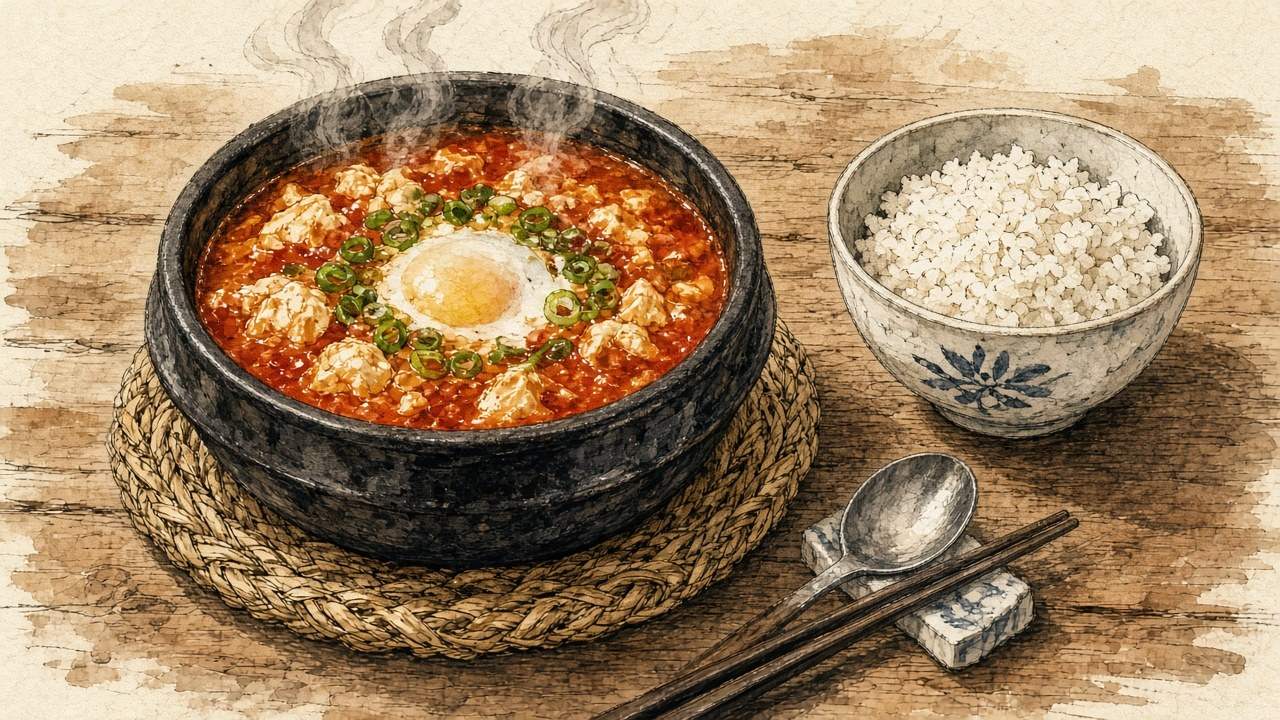
Sundubu Jjigae (Soft Tofu Stew)
Stir-fry Korean leek and gochugaru over low heat to make chili oil, cook the pork through, then add water. Spoon in the soft tofu in big pieces, and finish by stirring in a beaten egg.
한국어로 보기 (Korean version)
Steps
- 1
Finely chop the pork and coarsely chop the onion. Separate the white and green parts of the leek and slice both thinly, and slice the chili on the diagonal.
The finer you chop the pork, the faster it cooks and the more evenly it spreads through the broth.
- 2
Put the oil and the white part of the leek in an earthenware pot (ttukbaegi) and stir-fry over low heat for 1 minute until fragrant, then add the gochugaru and stir-fry 30 seconds more.
Gochugaru burns quickly and turns bitter, so don't turn up the heat.
- 3
Add the pork, onion, and minced garlic and stir-fry over medium heat for 4 minutes, until the pork is cooked all the way through with no pink inside.
- 4
Add the water and guk-ganjang. When it comes to a boil, spoon in the soft tofu in large pieces and simmer over medium heat for 5 minutes.
Don't stir the tofu; just spoon the broth over the top so the pieces stay intact.
- 5
Drizzle in the beaten egg, top with the leek greens and chili, and simmer 2 minutes more. Season with salt.
Substitutions
| Instead of | Use | How |
|---|---|---|
| pork shoulder | a handful of clams, purged of sand | Add the clams after the water and simmer until they've all opened. Skip them if you have a shellfish allergy. |
| guk-ganjang | 1 tsp saeujeot (salted shrimp) | Saeujeot gives the broth a cleaner, brighter taste, but avoid it if you have a crustacean allergy. |
Storing leftovers
Over time the soft tofu releases water and thins the broth, and the egg gets rubbery, so it's best eaten the day it's made. Cool any leftovers, refrigerate, and eat within 1 day; when reheating, bring it to a rolling boil all the way to the center. Soft tofu falls apart when frozen, so don't freeze.
Serve with
Rice, gim (roasted seaweed), and a cool, refreshing side like oi-muchim (seasoned cucumber). To tone down the heat, serve gyeran-jjim (steamed eggs) alongside.
Making more or less
When splitting into two single-serving earthenware pots, make the chili oil all at once in one pot, then divide.
Questions
How do I adjust the spiciness of sundubu jjigae?
The heat comes from the gochugaru and the Cheongyang chili. Cut the gochugaru to 1 Tbsp and leave out the chili for a milder stew; if it's already too spicy, stir in one more beaten egg to soften the broth. Stir-frying gochugaru over high heat makes it more bitter than spicy, so keep the heat low.
More with the same ingredients