Soups & Stews
Eomuk-tang (Fish Cake Soup)
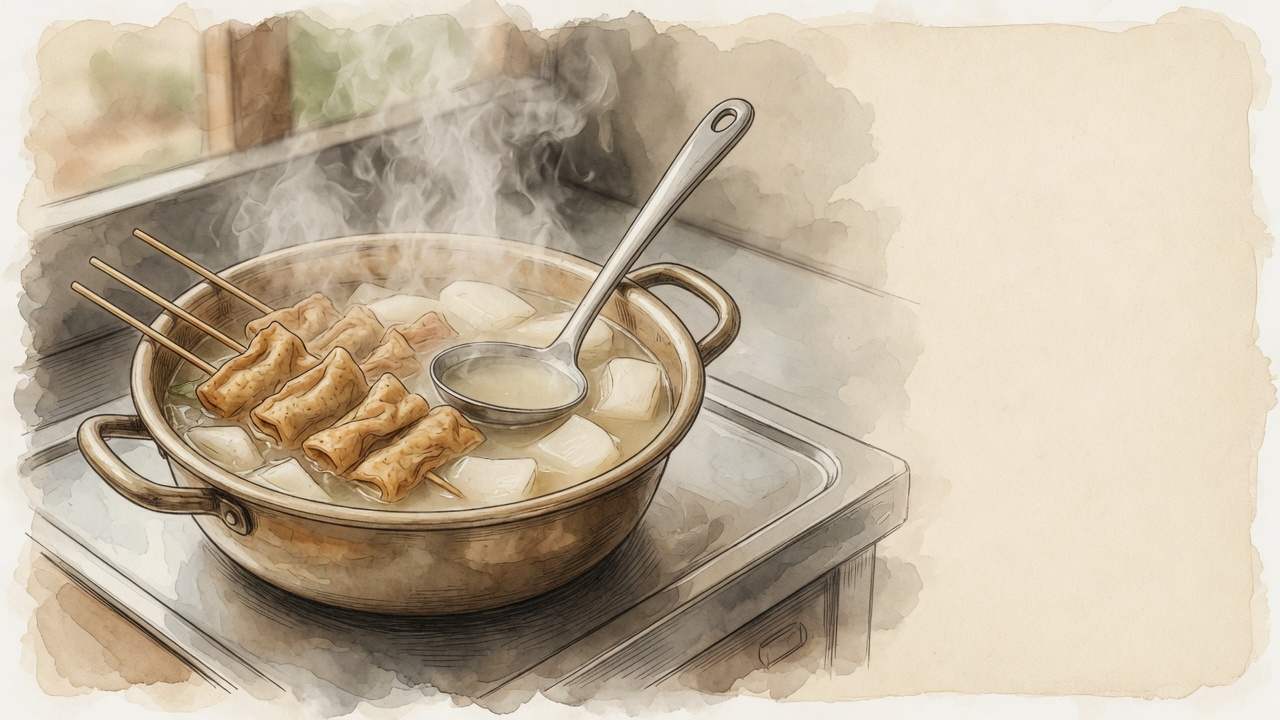
Steep the anchovy-kelp stock with radish long enough to make it clean and slightly sweet. Thread the fish cakes onto skewers, rinse off the oil, and add them at the end for just 5 minutes so they stay chewy instead of soggy.
한국어로 보기 (Korean version)
Steps
- 1
Cut the radish into 2 cm thick rounds and quarter them. Cut the leek into 5 cm lengths and slice the chili on the diagonal.
- 2
Fold the fish cakes in half lengthwise or into a wave shape and thread them onto skewers. Put them in a sieve and pour hot water over them to rinse off the surface oil.
Without skewers, cut the fish cakes into bite-size pieces and rinse them the same way.
- 3
Put the water, anchovies, kelp, and radish in a pot over medium heat. When it boils, remove the kelp, then boil 15 minutes more until the radish turns translucent, and remove the anchovies.
- 4
Add the soup soy sauce and garlic, then the fish cake skewers, and boil for 5 minutes.
Fish cakes left to boil long soak up the broth and go limp, so add them last.
- 5
Add the leek and chili, boil 1 minute more, and season with salt and pepper.
Substitutions
| Instead of | Use | How |
|---|---|---|
| dried anchovies and kelp | 1 stock pouch | Steep the pouch with the radish for the time on the package, then remove it. |
| Korean radish | 1/2 onion | Without radish, use onion for sweetness. Add it for the last 5 minutes of making the stock. |
| Cheongyang chili | none | Leave it out when cooking for kids and slice it over the adult bowls instead. |
Storing leftovers
Fish cakes left sitting in the broth overnight swell and lose their chew. Store leftover fish cakes and broth separately in the fridge for up to 2 days; reheat the broth first, then add the fish cakes and bring it back to a boil just once. The broth alone freezes well for udon or tteokbokki later, but cooked fish cakes turn spongy if frozen.
Serve with
Rice, kimbap, and tteokbokki. Serve it with snack-bar favorites, or with rice and kimchi as a full meal.
Making more or less
To make a bigger pot, scale the water and fish cakes together, and make up any missing seasoning with salt rather than soy sauce so the broth stays clear.
Before you cook
- Wooden skewers have sharp tips, so slide the fish cakes off for young children.
Questions
My fish cake soup tastes flat. What went wrong?
Either the radish did not steep long enough or there is too much water for the amount of fish cake. Cook the radish until translucent first, and if it still tastes plain, add about 1/2 tsp fish sauce for depth.
Do I have to rinse the oil off the fish cakes?
It is edible without rinsing, but oil floats on top and the broth turns greasy and cloudy. If your fish cakes are not very oily, you can skip it.
More with the same ingredients